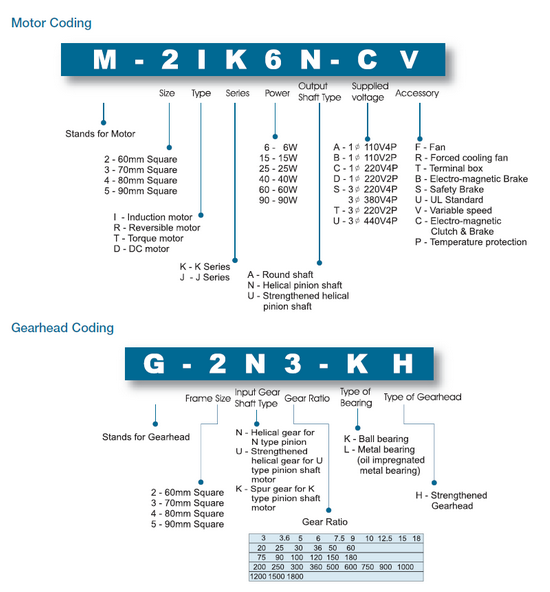
AC Gear Motor Guide
The
following is a quick and dirty guide that relates to all
Fractional Horsepower Motors (Gearbox type Standard Motors)
or Micro Reducer Motors.
It's boring, but what can we say? Its educational rather than
entertaining!
Things you should watch out for when buying a gear motor from India or China or buying from sellers offering these!
The
most common problems that we saw when we tested various motor
and gearbox combinations (especially from China and India)
was the power rating and torque ratings. Not all were bad,
but most left a lot to be desired.
While the labels may say 90w, you push to get 70-80w out of
the motor. The wattage claims in most cases are just
fantasy.
Cheap gearboxes didn't maintain anywhere near the torque
claimed. Yep, we actually broke gearboxes testing this
out.
The precision industrial claims from sellers are a far reach from reality!,
on all the Chinese and Indian motor/gearbox
combinations we tested, there wasn't much precision at all.
On a good gearbox, you can't hear the gears mesh.
How to tell if your motor is Chinese or
Indian made?
Simplest way, just ask the seller for a 60mm mounting
bracket!
They wont have one or be able to get one, or if they can, it
will be much more expensive than the 80mm and 90mm ones they
sell (because they have to buy it from one of the big brands
which are much more expensive!)
The next best way is to ask for an interdecimal gearbox (or
middle gear) as they are sometimes called.
No Chinese manufacturer makes a 60mm mounting bracket! and
they also don't make interdecimal gearboxes for the all the
60mm 80mm and 90mm gearboxes!
Some may make one for the 90mm or another may make one for
the 80mm but no single manufacturer makes all three.
The next way is the seller wont send you the motor and
gearbox separately. They will come already joined!
The seller may claim its so it's connected properly or so you
don't have to do it, or whatever. the fact is, the shafts are
matched to one another. From a Chinese manufacturer this
feature costs extra!
Fact is, if you buy 2x60w motors and 2x 50:1 gearboxes, when
you receive them, swap the gearheads over!
You'll notice they will be quite noisy! This is because it
takes much longer for them to match to a generic precision
shaft than to match to the shaft already in the
machine!
Overview
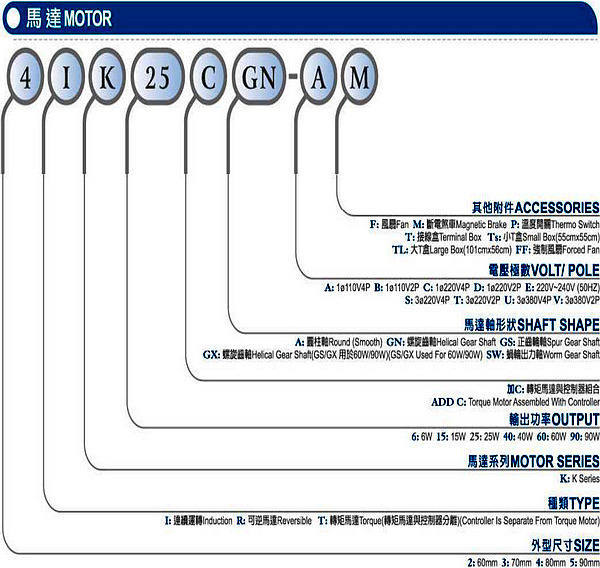
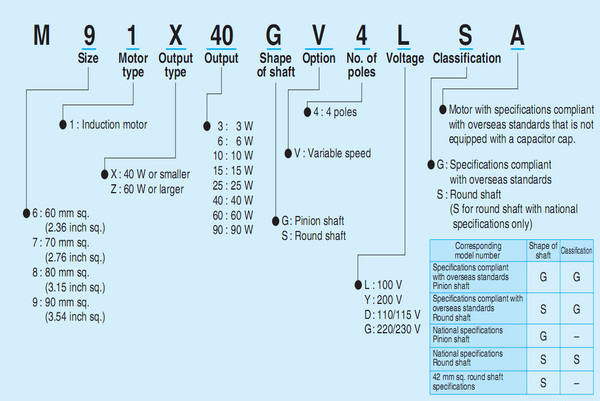
All standard
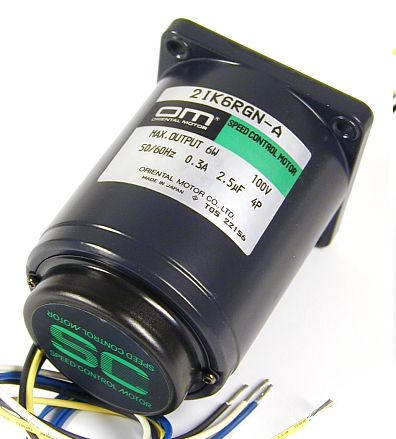
Fractional Horsepower Motors ('Standard' motors or 'Micro
Reducers') are built all over the world with primary
manufacturing in Japan (Panasonic, Oriental) Taiwan (GPG,
Sesame) Korea (SPG, Astero) and China (ZD, Honlite, Zhongda,
Dongzhen, Longway and others).
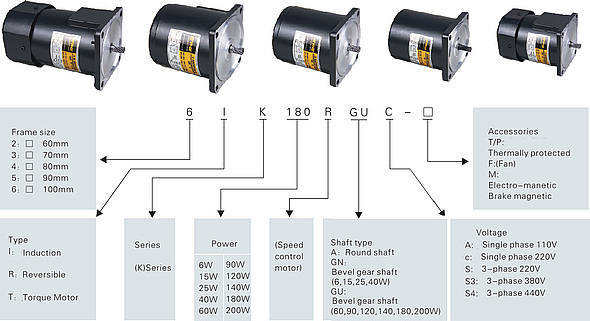
They are available in a certain range of configurations,
which are only going to ever be Induction, Reversible,
Electromagnetic Brake, Speed Control, Speed Control plus
Electric Brake and DC (and rarely Torque). They can be
purchased without gearbox, but it is not common because it's
hard to fit anything directly to a gear cut pinion shaft
unless you specifically order one with a straight
shaft.
Newer additions to the standard motor range in the last few
years have been 100mm frame sizes, Brushless motors and
Planetary gear heads. Though these products are not common
because with the much higher costs they are rarely used where
something cheaper will substitute. We have to say that
brushless is very efficient for DC, but gets expensive
quickly because not only do you need to pay mega bucks for
the motor, the controller costs a small fortune too. On top
of that, the more bits it takes for a motor to operate, the
higher the chance of failure or breakdown. So currently,
while brushed may well be less efficient it's reliable and
proven.
Click the following links to go directly to see out range of Fractional Horsepower Motors in the GPG AC/DC series Induction Motors, Reversible Motors, Speed Control Motors and Electromagnetic Brake Motors
Geared AC Induction Motors
Induction motors
are the most commonly used of all standard gearbox motors.
The motors are suited for continuous driving at a constant
speed. They operate at various voltages from 110 volts AC
Single Phase, through to AC 415 Volt Three Phase. All Single
Phase Induction Motors generally have power outputs between
roughly 4 Watts and 120 Watts (50Hz power zones), though in
some brands single phase can go as high as 150-200w (more
common in the 60hz power zones), though the precision and
efficiency must be extremely high or the motor gets too hot
and will trip the thermal protect feature. Three Phase is
available in up to 200w in a 90mm Frame size. Frame sizes
range from 60mm through to 100mm, though both 70mm and 100mm
are rarely seen and the reason for this is with the 70mm,
most stockists don't want to carry a huge amount of gearboxes
when one of the other frame sizes will already have something
equivalent to cover them and with the 100mm its due mostly to
the cost.
Terminal boxes are available dependant on each individual
manufacturer, starting at either 6W, 15W or 25W. Most start
at 15W or 25w. Brushless DC motors are available from a lot
of manufacturers, though the cost is prohibitive with the
controller and generally speaking is really not viable unless
required for a specific purpose and also adds to design
challenges as the controller needs to be accounted for
too.
Geared Reversible Motors
Reversible motors
differ from Induction motors in that they have an added
damping brake for quick stopping of the motor for rotational
direction changes or even speed changes (which is why they
are used on speed control motors), they are generally not
made for continuous operation as the brake generates heat for
slowing or even changing motor rotation direction. They have
a higher starting current draw than an induction motor which
better enables them to shift rotational speed, but increases
heat. Their ratings are always 30 minutes, and despite some
claims they are NOT continuous on any motor from any
manufacturer of this range. They can be run constantly if
there is no frequent rotational changes or speed changes
ONLY (in which case you may as well have chosen an
induction motor). Available in Single and Three Phase.
Terminal boxes are available dependant on manufacturer
starting at either 6W (less common), 15W (More common) or 25W
(Most common). Available from 6-200 Watts (manufacturer
dependant).
Geared Electromagnetic Brake Motors
Magnetic Brake motors are basically a Reversible motor with a modular Magnetic Brake clamped to the rear of the motor. Has the advantages of quick stopping and holding power. The actual holding torque varies between manufacturers but is mostly seen to be between 0.5 (Nm) and 3 (Nm) depending on the configuration and design of the brake (including frame and brake size). Most are copies of the Oriental Brake, though recently a few manufacturers have been using their own designs to great effect. Quite an expensive addition, and depending on the manufacturer, sometimes not available in the 60mm Frame size (Not that it's difficult to build, its just not a big seller so the brake manufacturer makes them, though at much higher costs than in the more common sizes 80mm-90mm). Available in Single and Three Phase. No Terminal Boxes usually available in this series. Available from 6-200 Watts (manufacturer dependant)
Click the following links to go directly to see out range of Fractional Horsepower Motors in the Titan Budget AC series Induction Motors, Reversible Motors, Speed Control Motors and Electromagnetic Brake Motors
Geared Speed Control Motors
Speed control motors are also known as "Variable Frequency Drives" (VFD) or "Variable Speed Drives" (VSD) and even "Speed Reduction Drives". These are basically a Reversible Motor with a Tachometer feedback device stuck to the rear of the motor to give constant feedback to the speed controller (inverter). These are a closed loop type speed controller. Have the advantage of constant speed regardless of load due to the feedback from the tachometer attached to the rear of the motor, which causes the controller to vary the frequency delivered to the motor for a constant pre-set output speed. Speed Control modules are available in either Digital or Analogue versions, with the digital model having the advantage of being able to visually display the motor speed (BUT NOT THE GEAR SHAFT OUTPUT SPEED), though are generally more expensive. No Terminal Boxes available in this series and the range is limited to Single Phase only. Available from 6w-200 watts. Start run capacitor will either be internally mounted or externally mounted to the speed control. If you wish to speed control a 3-phase motor you will need a 3-phase Inverter VFD, if you get stuck though and require one but can't find one, we can source them locally or put you in touch with Australian distributors.
Generally all speed controllers will handle up to 140w, the only difference between a 6w and a 90w speed control module is the capacitor, so if you have a 6w speed controller and a 90w motor you just need to change the capacitor (though we don't recommend you try this unless you know what you are doing)
DC Gearbox Motors
DC motors also known as PMDC ("Permanent Magnet DC Motors") or DC Brushless (also known as BLDC motors) are commonly available in either DC 12, 24, 90 Volts and rarely 180 Volts and above. DC ranges, are secondary products to the above AC Gearbox range with a lot of manufacturers having them made by 3rd party manufacturers. Available up to 300 Watt in a 90mm frame at either 24 or 90 Volts from the high quality manufacturers, though cheaper manufacturers seem to get stuck getting past 180 watts power output in a 90mm frame (less efficiency, lesser quality materials) and generally must go to a 100mm frame instead.
As a rule of thumb if you need anything past 90W-120W (unless for a specific industrial application) its best to start looking at other options because past this point the cost just explodes as this usually means you need more than 19.6Nm of torque which is the upper limit of the 5GU/S9KC capacity and really, past this point is the next size gearbox in a 90mm frame comes with a massive 29.40Nm of torque, but at this stage you just blew the bank.
Regardless, its definitely not the most cost efficient for high power applications. Try looking at 12/24 Volt industrial Planetary gear heads/gearboxes. Easily speed controlled with a Pulse Width Modulation (PWM) speed controller which we offer on our DC speed control page (shameless plug).
Oh and one last thing!, most manufacturers can safely claim a 2000 hour brush life, and while a few of the higher quality brands can achieve it, no budget motor gets anywhere NEAR this figure (we're talking constant speed testing here). So that's something you should always be aware of.
Gear heads
Gearheads also
known as Gearboxes or Gear Reducers, (they all amount to the
same thing). Use a combination of Helical and Spur gears to
adjust the output speed of the motor to slow the speed while
increasing the torque. This is the strength of the entire
standard motor range which has seen it used across so many
industries in so many countries.
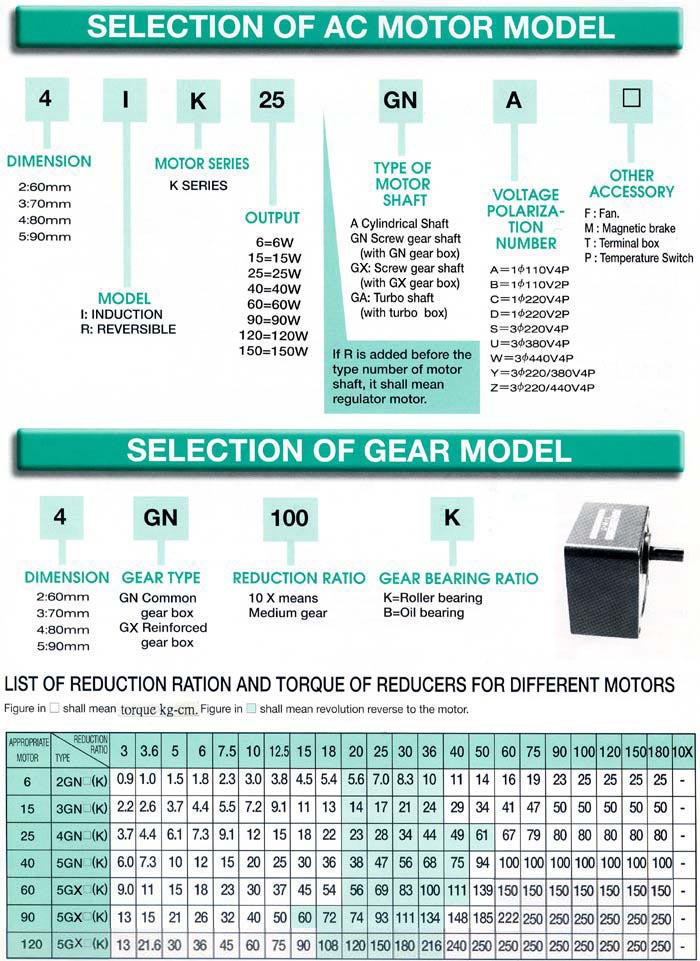
Ratios generally start at 3:1 and go all the way through to
850:1 though this is really manufacturer specific. Most
manufacturers will go up to either 180:1 or 200:1 simply to
try and limit the available torque and preserve the life of
the gearbox (higher ratios = less efficiency but higher
torque = faster wear). Some also manufacture what is
known as an Inter decimal gear head or Intermediate gearbox,
which gives a further 10:1 reduction before the gearbox, and
is hooked directly to the motor output shaft allowing the
gearbox to then be attached to the output shaft of the
Interdecimal gear head which is identical to the motors own
helical output shaft. An example of output for a motor at
1400 RPM with a Interdecimal gear head and a 50:1 ratio would
be (1400/10) /50 = 2.8 RPM. With a 200:1 gearbox that figure
could be as low as 0.7 RPM.
Some of the extremely efficient companies that produce
standard motors use a different spur cut from 3:1-5:1 and
200:1 and above. It's there to increase transmission
efficiency, but can be painful experience for the
stockist who must keep multiple motors of the same type and
multiple gearboxes for each different motor.
We know that these gearbox ranges use a combination of
Helical and Spur gears, so why don't they use all helical
gears in the gearbox? Simple, Efficiency.
Why not all Spur Gears in the gearbox? Strength
Why not all hardened Spur and Helical Gears?
Noise
Why not all Planetary? Cost.
Why is the maximum limit 19.6Nm? Safety and longevity. You
*should* be able to overdrive to about 22Nm with no
ill-effects but really past 19.6Nm you begin to stress the
gearbox.
A word of warning, don't attempt this on cheap
gearboxes, as most of them begin to stress at anywhere from
15Nm-19Nm (we know, we tried!).
You might see some ratios where the gearbox hits its peak
torque output way before the ratio gearbox selection ends, ie
you'll hit 19.6Nm at 60:1 Ratio even though the Gearbox range
goes up to180 or even 250:1, basically this is telling you
that while there is much more torque available, you really
don't want to use it, or you risk the gearbox going nuclear.
Don't put side loads directly onto the gearbox (Radial) as
the bearings in the output shaft are not designed for this
and will wear out much faster. If you want to use tension
belts then you will need a torque gearbox which has super
heavy duty bearings and usually a more robust case in order
to take increased pressure in the radial and thrust
positions. I once advised a client about a side load I
thought may have been a little excessive, but for him all
that mattered was that it worked. Not even a month later he
came back to the shop and showed me the result, which was an
elongated output shaft opening on the gearbox. A simple
bearing or coupling would have saved him $290.
Planetary gearing (gearboxes) have recently become available
for these motors, but are generally rare because of the cost
involved in the manufacturing process and complexity of
design though they are also capable of big torque and greater
efficiency. Some manufacturers even list worm drives for this
motor range, though usually it requires a straight shaft
motor output rather than a gear cut (Helical) shaft and the
right angle or worm drive is nearly always manufactured by a
third party. This is the same as Right Angle gearboxes, which
are nearly always worm drives.
People
occasionally ask me why they chose the strange ratios for the
gearbox ranges, ie 3 to 3.6 or 7 to 7.5 etc, the reason is
pretty simple. It's actually 2 sets of gearboxes. One for
50Hz and one for 60Hz. Because at 50Hz the motor has an
output of 1350-1400 RPM and the 60Hz has 1500-1700 RPM.
So 3, 5, 7.5, 12.5, 15 etc etc are 50Hz and 3.6, 6, 9, 15, 18
are 60Hz meaning they utilise different gearing to maintain a
common speed for different areas of the world. So for example
if we need say a 500 RPM output, for 50HZ we would use the
3:1, for 60Hz areas we would use the 3.6:1. All the
gearboxes can be used for any region, It doesn't matter if
you use a 3 or 3.6 because they all fit the same motor, but
it has the advantage of fine tuning your RPM output
speed.
Very condensed, and probably boring to read but hopefully informative. I tried to clean it up a little so it's easier to understand. If I've missed anything please feel free to email us.
Categories
Information
News
- 19-01-2012
- New speed controllers coming soon!
- 03-01-2012
- Welcome to 2012!
- 22-09-2011
- How to calculate shipping prices!
- 07-06-2011
- Specials on E-Bike Motors, Titan Motors and More!
- 01-06-2011
- International Shipping methods changed
- 16-03-2011
- New products and more!
- 16-01-2011
- Welcome to 2011 !
- 31-10-2010
- Long time and No updates!
- 11-09-2010
- New DC Motors and NEW Speed Controllers!
- 11-08-2010
- Interesting happenings of the week!
- 03-08-2010
- Customer Projects added!
- 17-06-2010
- Good Feedback!
- 05-02-2010
- Planetary Geared motors have Landed!